


Go Back Go Back Go Back Go Back Go Back Go Back Go Back Go Back Go Back Go Back Go Back Go Back Go Back Go Back

Pothole Mosaics





Jim Bachor Jim Bachor Jim Bachor Jim Bachor Jim Bachor Jim Bachor Jim Bachor Jim Bachor Jim Bachor Jim Bachor
Visual Art Visual Art Visual Art Visual Art Visual Art Visual Art Visual Art
 Trying to leave your mark in this world fascinates me. Ancient history fascinates me.
Volunteering to work on an archaeological dig in Pompeii helped merge these two interests into my art. In the ancient world, mosaics were used to capture images of everyday life. These colorful pieces of stone or glass set in mortar were the photographs of empires long past. Marble and glass do not fade. Mortar is mortar. An ancient mosaic looks exactly as intended by the artist who produced it over two millennia ago. What else can claim that kind of staying power? I find this idea simply amazing.
Using the same materials, tools and methods of the archaic craftsmen, I create mosaics that speak of modern things in an ancient voice. My work locks into mortar unexpected concepts drawn from the present.
By harnessing and exploiting the limitations of this indestructible technique, my work surprises the viewer while challenging long-held notions of what a mosaic should be. Like low-tech pixels,hundreds if not thousands of tiny, hand-cut pieces of italian glass and marble comprise my work.
This work is my mark.
You can indeed: LINK
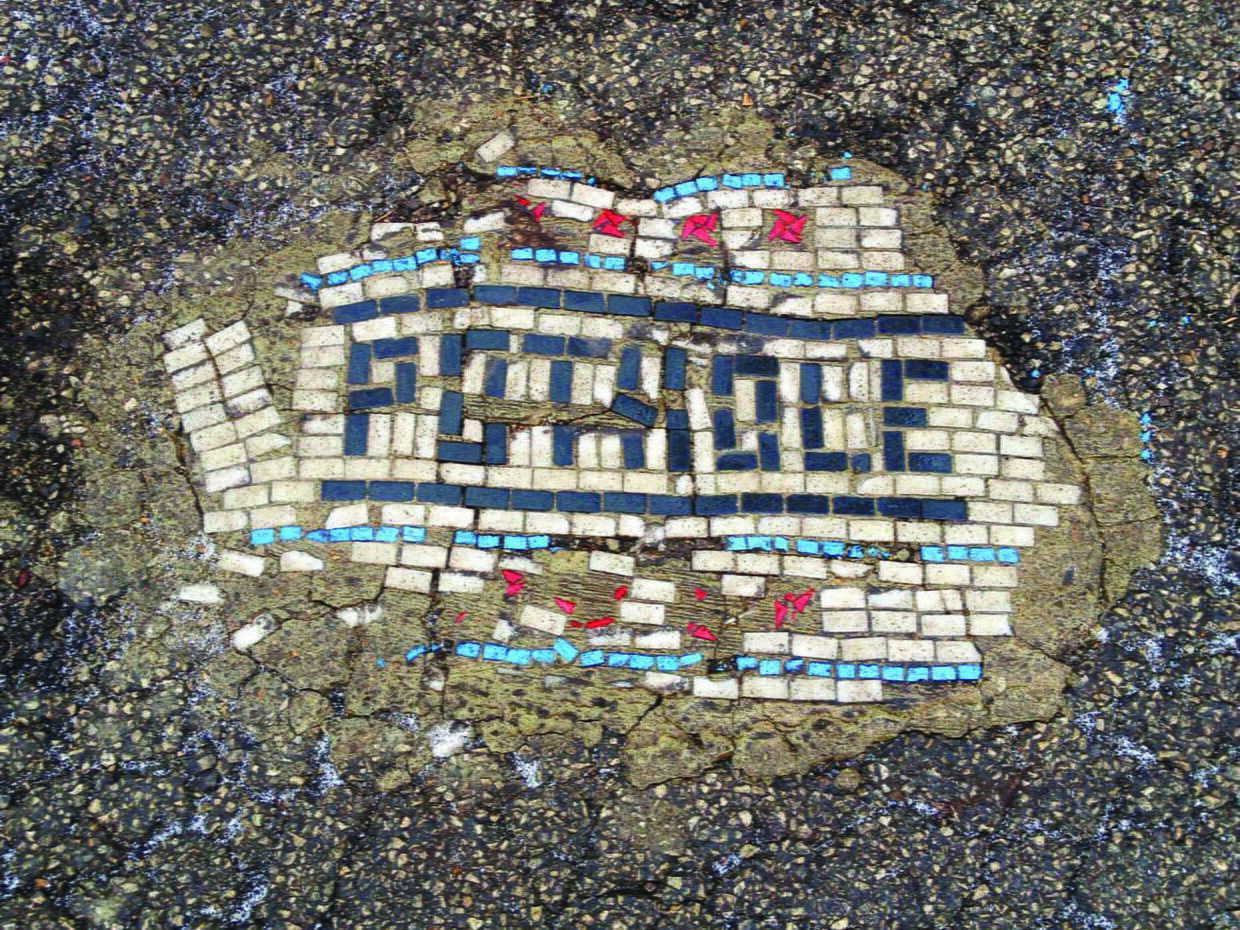
I thought that this public artwork, created by Jim Bachor and featured in this Colossal article, was both funny and heartwarming (a much needed combination of emotions in today’s day and age). Bachor has created a series of tile mosaics to fill in potholes in Chicago, with two of the mosaics inspired by essential items associated with COVID-19 (a roll of toilet paper and a bottle of hand-sanitizer). Bachor uses playful colors and fun backgrounds to give a sense of hope and light-heartedness, which I think is a really admirable tone for the artist to choose to embody when creating something related to a serious and sometimes heartbreaking public health situation. He’s also made some other pothole mosaics unrelated to COVID-19, which offer similarly unexpected patches of fun and color in the otherwise everyday experience of walking (or driving) down the street.
One thing that particularly stood out to me on reading the Colossal article was Bachor’s commentary on how some people perceive his works as political statements intended to spur the city government to fix the potholes. Instead, Bachor says, “[the potholes] are an unsolvable problem…. I actually have empathy for city government. It’s a no-win situation.” The real motivation behind Bachor’s pothole mosaics is “[to] keep myself connected with people that like my work but might not be able to afford an original or print.” I think that’s a great sentiment.